12 March 2021

Rarible NFT's - Buckethead Art & More

Having collected various original art works over the years, you can imagine my delight following the explosions of NFT's (Non-Fungible Tokens) recently. 

All of the below pieces are original. I own the tangible and digital versions. They were all commissioned from various artists online and some who I know personally. I did not create them myself, I am merely a collector.

They will all, at some point, be listed on my Rarible page.

This page will be updated to reflect any changes in the listings/availability.


1.  Buckethead Original       


Price:                     6 ETH

Framed Size:        48cm x 58cm

Commissioned:    2016

Medium:                Ink

Original:                Yes

Subject:                 Buckethead

Available:              1/1


2. Buckethead Original II


Price:                    6 ETH

Framed Size:       55cm x 63cm

Commissioned:  2016

Medium:              Ink

Original:              Yes

Subject:                Buckethead

Available:             1/1


3. Buckethead Original III
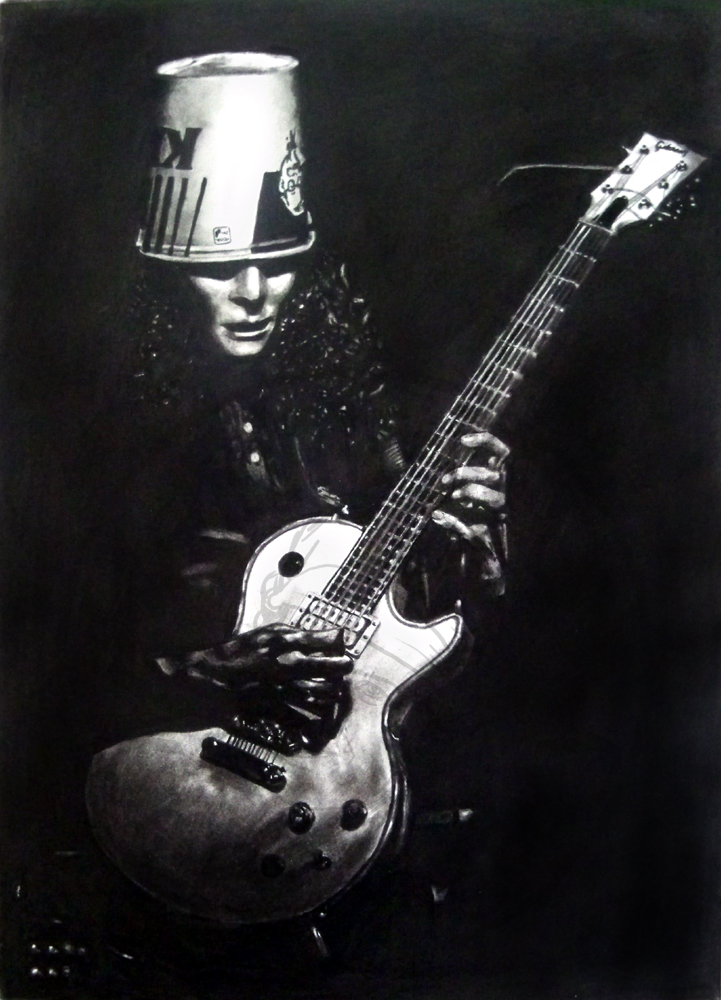

Price:                     6 ETH

Framed Size:        42cm x 52cm

Commissioned:   2015

Medium:               Charcoal

Original:               Yes

Subject:                Buckethead  

Available:             1/1


All three artworks are based on the same image, yet all have their own unique characteristics distinguishing one from the other. 

If you have any questions I would suggest posting a comment or, if you value your privacy, use the Get In Touch feature to the left and I'll get back to you. 

Here are all three originals sitting idly next to each other.


More Below

4. Batman 1989's Joker

Price:                    4 ETH

Framed Size:        40cm x 30cm

Commissioned:    2014

Medium:               Ballpoint Pen

Original?               Yes

Subject:                 The Joker


1 January 2016

Votive Veganism

Eating meat is natural. It's part of the biological life cycle. Without it, we'd be withering anemics whose daily energy expenditure would be more or less entirely burned with the lifting of a pencil. Right?

"How can you just stop?". Well, the answer is simple: 

Where there is no need, there need not be desire. 

This is a simple, life altering perspective.

Plainly put, contributing to mass animal slaughter/consumption is morally repulsive and little reason, beyond habit and greed, exists for its continuation. Of course, eating meat - or anything else for that matter - begins involuntarily. Parents slowly start familiarising their child with different types of cooked animal flesh from an early age. This continues throughout her teenage years as she learns which species tastes the best after it's been deep-fried. Along the way, she might reject some species in favour of others. Then she will move out, start her own family, and continue the cycle of serving up for her children a dinner made from something that was living and breathing probably just a couple of days before. 

But couldn't the same principle I'm criticising be applied to all other foods, I hear you mumble? No, it could not. It is true that a child has no say in what she eats, but it's not true that parents have no meat-alternative to offer. There is no law forcing citizens to include meat in their diet, and rightly so. In society today animals are bred, reared and butchered at an unbelievable rate, and made available at a low profit margin. The latest OECD-FAO figures estimate that by 2019 the average amount of poultry consumed in the world will be 15kg/person/year. If that's not unsettling, consider this: It is estimated that, in the US and UK alone, approximately 50,000,000,000 - 100,000,000,000 chickens are killed each year. You can find similarly disturbing numbers pertaining to cattle, sheep, fish, and pigs.

Then why should we care? It's all food at the end of the day, is it not? The sole purpose of these animals is to grow large enough to make their way onto our dining tables. Well, no, that's not their purpose at all. The reason you should care is because they have interests which must be taken into consideration in our treatment of them. They cannot be compared to vegetables. They are not synonymous with 'food.' A comparison between a cow and a cabbage is no more meaningful than that between a leak and a lion. Animals are sentient. They have interests and desires. Most importantly, however, they can feel pain. As Bentham put it:

"...It may come one day to be recognized, that the number of legs, the villosity of the skin, or the termination of the os sacrum, are reasons equally insufficient for abandoning a sensitive being to the same fate. What else is it that should trace the insuperable line? Is it the faculty of reason, or perhaps, the faculty for discourse? The question is not, Can they reason? nor, Can they talk? but, Can they suffer? Why should the law refuse its protection to any sensitive being? The time will come when humanity will extend its mantle over everything which breathes."

And so our actions must respect this principle, for there is not a single animal on this planet without the capacity to feel pain. It is not disputed that there are varying capacities or thresholds for suffering. A pig, for instance, is most likely capable of feeling more pain than an ant - not least because there's not much scope for causing anything other than instantaneous death to an ant. But why must we disregard an animal's suffering, regardless of its severity, by virtue of its membership of another species? We mustn't. In Richard Dawkins' interview with Peter Singer, the former proposed that just as there exists a continuum of capacity within sentient beings to feel happiness or pain or anything else, therein lies the continuum of moral responsibility we owe to them. Hence, our moral responsibility to a turkey or a cow is proportionately more than it is to something with a rudimentary nervous system, like an oyster or sea squirt. Although, ultimately, Dawkins failed to defend the morality of his position as a meat-eater, important discussion was had between the two.  

Animals are capable of, and often do, feel things like regret, remorse and bereavement. These are not exclusive to us. "The fact that some people are not members of our race does not entitle us to exploit them, and the fact that some people are less intelligent than others does not mean that their interests may be discounted or disregarded." says Singer. What makes our species - the oh so mighty homo sapien conquerors - any more important than a newt or ostrich or goat? Nothing. We are capable of communicating via hundreds of sophisticated language structures, we are able to comprehend and utilise the laws of physics to facilitate exploration of outer space, and we have figured out a way of alienating connecting the entire human race through a small hand held device. Yet, none of these achievements make our lives any more important than a member of a species that is not privy to such advancements. Should you find yourself disagreeing with this notion, you'd be falling in the newly coined category of speciesism. No dramatic variations from racism or sexism, really.  You see others as inferior and unworthy of the same respect. Unfortunately, much of our kind supports speciesism. Whether you like it or not, if you eat or drink or wear anything consisting of something which once lived, you're a speciesist. A living thing had to suffer for your preference.

A popular defence to speciesism is the argument pertaining to nature. 'It's natural' or 'that's how it works in the wild' are the frontrunners. While there's no doubt that animals in the wild eternally entertain a kill-or-be-killed mentality, the same is not true of our kind. Our ancestors first lived off Mother Nature before developing the aptitude, courage, and weaponry to hunt other living beings. And so we cannot be said to be dependent on meat for survival. Consider the silverback gorilla - the largest of all primates - with her high-domed skull and dagger-like teeth, capable of penetrating even the thickest bones in our bodies. What does she eat? Plants. 
Unlike us, wild animals rarely have a choice in deciding what to eat. Of course a carnivorous animal like a lion will hunt and kill a lone fawn it finds in its territory. Not because the fawn is intruding or risking the safety of the lion's pride, but because it's a source of food. That's it. There is no evidence to suggest there's much thought that goes into any such ‘decision’ – even if it counts as one. It's really an instinct. That lion is incapable of considering the interests of the little fawn. Animals end lives to avoid the ending of their own. That is the extent of their reasoning. Humans, for the most part, have a far more advanced ability to reason. We are capable of considering the consequences of our actions. We weigh opposing factors and act according to our best judgment.  Again, for the most part, we can distinguish right from wrong. And so we need not bind ourselves to the traditions of our hairy forefathers, for we have an abundance of food to choose from. We have the ability to choose the right option. The option that was not dependent on suffering. 

That the treatment of these animals prior to their killing is anything but revolting is simply untrue. In many cases, somewhere between their unfortunate births and miserable deaths, millions of chickens endure crammed journeys to the slaughterhouse where they die from suffocation. Those that remain are violently shackled upside down before having their throats cut by a machine (yes, machines are higher up in the pecking order). Sometimes the chickens miss the blade, and are scolded alive in boiling water. A trip to the supermarket will offer you the chance to purchase fresh, healthy alternatives to what you've been eating your entire life.

Issues surrounding equality, discrimination or justice, much like issues of war and conflict, are invariably based on the prejudicial attitudes of one group towards another, in one form or another. Our attitude towards our fellow earthlings is no different. The majority of us are content with contributing to this animal holocaust, for that is what it is. We readily degrade, discredit and devour other species. But as soon as we see the process through which they're killed, our stomachs turn. We know it's abhorrent. We know they don't deserve it. And we still go on, like it doesn't really matter. After all, there's a big difference between hunting and buying. 

I'll leave you with another valuable quote, again from Singer:

"The belief that issues about humans should always take precedence over issues about animals reflects a popular prejudice against taking the interests of animals seriously. A prejudice no better founded than [that] of white slave owners against taking seriously the interests of their African slaves."

10 October 2015

Designer Babies

“In caring for the health of their children, parents do not cast themselves as designers or convert their children into products of their will or instruments of their ambition. The same cannot be said of parents who pay large sums to select the sex of their child (for nonmedical reasons) or who aspire to bioengineer their child’s intellectual endowments or athletic prowess … parents bent of enhancing their children are more likely to overreach, to express and entrench attitudes at odds with the norm of unconditional love.”

Sandel, M., The Case Against Perfection: Ethics in the age of bioengineering. Cambridge, MA: Belknap Press of Harvard University. 2007. Loc 349

As humanity’s collective efforts in technology and medicine continue to advance at an exponential rate,[1] individuals are presented with an ever-increasing pallet of options to meet their needs. A woman who may be presented with a health risk as a result of pregnancy is able to control her fertility through the use of contraceptives.[2] A man whose waning organ function is likely to cause his death may rely on his brother’s generosity and good health to offer him a chance of survival.[3] A child who has a genetic disposition to a neurodegenerative disease has the opportunity of undergoing an MRI[4] to identify potential symptoms in order to facilitate early treatment.[5] These developments serve to remind us that we are fortunate to live in an age in which many of the threats to our eudaimonia can be combatted. However, such medical advances do not come without their own set of moral quandaries. Recently, the UK voted in favour[6] of a procedure that will allow doctors to transfer the mitochondrial DNA from one woman into the egg of another, effectively creating a baby with three parents.[7] Critics of this process are concerned that the consequences of such genetic engineering will lead to a dystopian society in which parents are free to select their children’s traits and characteristics.[8] The deliberate modification of an organism – for the purposes of this essay, children – through the alteration of its genetic code[9] are often referred to as ‘designer children.’ The aim of this essay is to consider the philosophical works of Michael Sandel and John Stuart Mill in determining how the position of each thinker would engage with the question of parental selection of infant characteristics through technological means. In doing so, focus will be placed on autonomy and prevention of disease.

We live in an age where the possibility of designer babies is no longer HG Wells territory.[10] Parents may soon be allowed to select certain desired qualities of their child, such as eye colour, intelligence, and athletic ability, pre-birth.[11] According to Sandel, this possibility means that we are faced with a promise and a predicament; on the one hand, our increasing knowledge and awareness will enable us to prevent a host of debilitating diseases. On the other, it will enable us to manipulate our own nature.[12] One argument in favour of biological enhancement is the ‘chance’ argument. This line of reasoning concludes that as humanity is now on the verge of possessing the authoritative tool of dictating its nature, a failure to utilise it would result in a moral culpability for the results of the natural lottery.[13] In his book, ‘The Case Against Perfection,’ Sandel submits a number of arguments against this position. For him, this ‘moral vertigo’[14] requires an analysis of the fundamental reasons how such practices diminish our humanity.[15] Perhaps his most prominent argument is that of the ‘openness to the unbidden.’[16] What is being questioned here is the nature of the mentality possessed by the designing parents, in particular their quest to master the mystery of birth. Sandel suggests that such a prospect will disfigure the relationship between parent and child, depriving the parent of the humility and sympathies which follow the sincerity of embracing what nature chooses to give us.[17] This argument makes sense insofar as it is accepted that the perceived benefits outweigh those so perceived by the designing parents. What an ‘openness to the unbidden’ may cultivate for one may of equal magnitude impede for another. Are we to value the ‘mystery of life’ to an extent that we sacrifice our ability to live what Aristotle described as the ‘good life’?[18] It appears, then, that these two notions of life are irreconcilable in this context. One might consider what allows Sandel the moral certainty to suggest that those who partake in selecting their children’s characteristics are missing out on what it really means to be a parent? Would it not be more suitable to make a comparison between the parents who ‘do’ and those who ‘don’t’? Instead, Sandel remarks in a very sweeping nature that those who ‘do’ are conclusively at fault, and, by implication, suggests that those who do not bear children possess only a deficient sense of reality, for they cannot appreciate the unbidden at all.[19]

For Mill, “human nature is not a machine to be built after a model, set to do exactly the work prescribed for it…but a tree, which requires to grow and develop…according to the tendency of the inward forces which make it a living thing.”[20] Such a description instinctively stands in the way of manipulation. However, it is unclear how far this argument can be taken given the many other ways in which parents can seek to influence their children’s lives. In any case, it may then be said that Mill and Sandel are in congruence on the matter; both thinkers appear to consider the designating and paving of the life of one’s child to be disagreeable. It is submitted that, for both, there exists an inherent importance on the uncertainties and experiences which will befall us throughout our lives, and – for better or worse – these are to be attributed greater value than the benefits which may befall us following someone else’s imposition of will or desire.

This leads to the argument concerning autonomy, which is said to be the liberty of any human being to have personal independence and freedom from external influence. Naturally, and irrespective of the stage of development, any influence over an unborn child will be contrary to its autonomy. The key question here is whether parents are bestowed an intrinsic right over the lives of their children, and, if so, whether that right usurps their children’s right to independence? Those who answer in the affirmative claim that genetic alteration, like music lessons or private tuition, is in the child’s best interests. 

Sandel is not persuaded by the autonomy argument for he considers it to bear false implications. He argues that, absent a designer parent, children would not be free to choose their physical characteristics for themselves.[21] Autonomy is not to be disregarded entirely, however, for there exists what Jürgen Habermas argues to be a violation of the children’s right to be the ‘sole authors of their own life history.’[22] Sandel subscribes to this argument, and further adds that even if no prima facie harm is inflicted on the child’s autonomy, the process is eerily similar to eugenics.[23] Thus, what he labels ‘eugenic parenting’ is immoral due to its entrenchment of a stance of mastery and dominance toward the world – hence omitting the appreciation of the gifted character of human achievement.[24]

Mill believes it imperative for individuality to be allowed to thrive. If genetic engineering became a normative procedure amongst expectant couples it would lead to what he depicts as the ‘wearing down into uniformity all that is individual’ in ourselves as a species.[25] Without the differences bought about by the natural lottery, we will - of our own accord - forever be prohibited from allowing humankind to be noble and beautiful objects of contemplation.[26] Consequently, any pre-birth intrusion would immediately deny the child the unhindered right to lay out her own path in life. Mill’s position is that everyone ought to have this right. Not necessarily because it is the ‘best’ path, but by virtue of it being her own chosen path.[27] This idea has limited application in reality. For example, would any difference exist between a murderer who kills for personal gratification and one who does so as a consequence of his gang affiliations? In both cases, the killer is the one conducting the killing. Legally, and perhaps morally, there would not be any leeway granted to the first killer merely by way of him acting according to his own ‘chosen path,’ any more so granted to the second killer simply because he was instructed to do so.

The next issue to be addressed is that of genetic engineering for medical purposes. The key question here is whether the idea of designer children is still disagreeable if the only thing being designed is a tackling of the child’s predisposition to disease? Efforts to prevent disease before birth (instead of treating it afterwards) have been described as ‘noble.’[28] They consist of PGD[29] whereby a six or eight-cell embryo is screened for genetic disease. Following the removal of the unwanted cells, the embryo is then implanted into the mother’s womb.[30] Some see this controversial procedure as an ‘unimaginable power,’ capable of altering the course of our humanity.[31] Conversely, would this process remain as morally divisive if it did not involve medical intervention? For example, would it be questionable for a mother to stand on her head during copulation, if, by way of some biological phenomenon, it significantly increased her chances of giving birth to a blond child?[32] It is conceivable that such practice would receive far less criticism. Moreover, those who cannot afford PGD often choose abortion upon prenatal discovery of their child’s unwanted condition.[33] A further question is raised when the unwanted condition is something that does not obviously meet that definition. In other words, is ‘culling the herd’ necessary if we are dealing with an unwanted sex, eye colour, or lower intelligence?[34] It has been argued that processes like PGD and abortion on the basis of disability or illness are fundamentally counterproductive due to their perennial societal effects. Members of disadvantaged communities[35] have long endured a struggle of inclusion, and to find their numbers dwindling serves only to reinforce the stigma attached to them.[36] It follows that the balance between healthier humans and an acceptance of diversity is becoming an increasingly difficult one to master.[37]

In Mill’s view, ‘actions are right in proportion as they tend to promote happiness, wrong as they tend to produce the reverse of happiness. By happiness is intended pleasure, and the absence of pain; by unhappiness, pain, and the privation of pleasure.’[38] This creed is the basis of Jeremy Bentham’s principle of utility on human nature. Thus, what must be assessed is whether genetically altering a child with the intention of preventing disease ultimately produces for society more pleasure or pain? This may appear an overly simplistic question to pose. However, Mill’s theory comes with an additional caveat: the existence of higher and lower degrees of pleasure.[39] Consequently, it may be said that one who selects her child’s characteristics, raises that child, and ultimately watches her blossom from and into their ideal extension of themselves experiences an elevated sense of pleasure - far greater than anything associated with a ‘primitive,’ ‘animalistic,’ or ‘lower’ one. Of course, the antithetical argument can just as easily be made. One may consider the unconditional love, compassion and acceptance a parent shows to her disadvantaged child as more beautiful and rewarding (and ultimately eliciting more happiness) than a parent who chooses to abort or one who seeks to modify her child’s genetic makeup with the intention of ‘fixing the problem.’ The latter argument holds true to those who attribute sanctity to all human life, irrespective of physical or mental capacity. It holds true for Sandel, who despite his emphasis on appreciating children as ‘gifts or blessings,’ maintains that the healing of a sick or injured child “does not override her natural capacities but permits them to flourish.”[40] He further adds that medicine has the telos[41] of restoring and preserving natural human functions that constitute health, and so no imposition on ‘the given’ can be said to exist in this context. There are two problems with this. First, one might ask what it might mean to say that children are gifts, for attributing the gift to nature would be an anthropomorphism – thereby rendering the idea of a ‘receiver’ and a ‘giver’ as questionable.[42] Secondly, Sandel fails to consider the numerous methods in which a child born with a disease can be treated, without necessarily overriding its natural capacities. Would a child born with a disease as detrimental to her cognitive development as PKU[43] be said to have had her natural capacities overridden by being placed on a special diet to alleviate the effects of her illness?[44] If the response is that such a diet would allow her natural capacities to flourish, what then are we to understand of one’s natural capacities? If “the given” encompasses all of the child’s natural capacities, can treatment or gene modification be said to override it? [45]

Having considered the writings of both Sandel and Mill, it appears that neither approach provides a satisfactory answer to the question of bioengineering of children. Mill’s principles are fundamentally too general to warrant satisfactory application to this matter, whilst Sandel makes persuasive arguments against this area of biotechnology without considering rather flagrant arguments against his position.

This particular area of scientific advancement is something that our morals are fully grasp. Perhaps as a consequence of this impending sense of power being available to parents, the moral issues raised within this area of parent-child relationships will cease to bear the significance, or the emotional weight with which they are argued, in future generations. Humankind has transformed rapidly over the centuries, leaving thousands of ethically challenging areas of discussion in its trail. The ethical arguments against engineering our children are based predominantly on speculative reasoning, which, much like other historically debated areas, are now debated for the sake of debate. In other words, we have accepted them and moved on, but debate subsists regardless. In a world in which the media and countless other forces play a significant role in shaping the characters of our children, perhaps parental intervention in this sense should be seen as a step forward in swaying the pendulum of parental power back towards the parents and not some external force. 

Is this opportunity a means through which parents can achieve their idea of what is in their children’s best interest, or will society reject the chance to embrace this advancement through fear of what could happen? That remains to be seen.


[1] Malinowski, 1996
[3] Doyle, Lechler, and Turka, 2004
[4] Magnetic Resonance Imaging
[5] Geva, 2006
[6] Gallagher, 2015
[7] Khazan, 2014
[8] Stanley, 2015
[9] Catalano, 2012
[10] Gallagher, 2015
[11] Margo, 2014
[12] Sandel, 2007, p. 5
[13] Savulescu, 2005
[14] Sandel, 2007, p. 9
[15] Ibid., p. 24
[16] A phrase coined and later borrowed from the theologian William F. May
[17] Sandel, 2007, p. 46
[18] Aristotle. Nic. Eth. 1097b
[19] Kahane, 2011
[20] Mill, 1869. p. 107
[21] Sandel, 2007, p. 7
[22] Ibid.,  p. 80
[23] Ibid.,  p.51
[24] Ibid.,  p.83
[25] Mill, 1869, p. 113
[26] Ibid.,
[27] Ibid.,  p.121
[28] Waldman, 2013
[29] Preimplantation genetic diagnosis
[30] Naik, 2009 ; Agar, 2006
[31] Catalano, 2012
[32] Keim, 2009
[33] Great Britain. Department of Health, 2014
[34] Vallero, 2011
[35] Such as cerebral palsy, cycstic fibrosis or down syndrome; see further: Abberley, 1987
[36] Harmon, 2005
[37] Ibid.,
[38] Mill, 1863, p. 9-10
[39] Ibid., p. 11
[40] Sandel, 2007, p. 46
[41] Aim, purpose or end-goal
[42] Strong, 2005
[43] Phenylketonuria
[44] Lewens, 2009
[45] Ibid.,